
- Long-form YouTube videos (10 to 20 minutes) account for 94 percent of AI search citations on YouTube.
- Shorts and videos under two minutes are cited just 5.7 percent of the time.
- How-to and instructional content is the most cited format. AI treats YouTube like a reference library.
- Channel size does not matter. Over 40 percent of cited videos have fewer than 1,000 views.
- Cutting long-form into Shorts does not transfer citations. The two operate on different rails.
Long-form YouTube videos in the 10 to 20 minute range now account for the majority of AI search citations on platforms like Google AI Overviews, Perplexity, and ChatGPT. Videos under two minutes account for only 5.7 percent of cited content. For founders trying to be discovered by AI search, long-form is the gate. Nothing else works without it.
This runs against everything social media coaches have been preaching for the last three years. Shorts. Reels. TikToks. Quick hits. Vertical video. Hook in three seconds. All of it built for the algorithm of the moment. None of it built for what AI search actually rewards.
What the data says about long-form and AI citations
According to research analyzing over 100 million AI citations across six major AI search platforms, long-form video accounts for 94 percent of all AI citations on YouTube. The largest single cluster falls in the 10 to 20 minute range at 32.1 percent of cited videos. Shorts and videos under two minutes barely register at 5.7 percent.
of all AI-cited YouTube videos are long-form. The 10 to 20 minute range alone accounts for 32.1 percent of citations across Google AI Overviews, Perplexity, ChatGPT, and Gemini.
This is not a small gap. It is a structural one. AI engines are not optimizing for entertainment. They are looking for source material they can extract and quote. A 30 second clip does not produce enough transcript text for an AI to meaningfully cite. A 12 minute teach video does.
The pattern holds across platforms. Google AI Overviews, Perplexity, ChatGPT, and Gemini all prefer long-form video as their video citation source. The handful of Shorts that do get cited come almost entirely from Google AI Mode and account for a tiny fraction of total citations.
Why how-to content wins the citation game
The format that earns the most citations is instructional. How-to and tutorial content gets cited more than any other category. Product reviews and explainers come second. Opinion pieces, vlogs, and brand commercials rank near the bottom.
The reason is simple. AI engines treat YouTube like a reference library. When someone asks ChatGPT or Perplexity "how do I build a revenue system that gets past five million," the AI is looking for a video that answers that exact question clearly and credibly. The closer your video looks to a how-to manual, the more likely it gets cited.
This is good news for founders. You do not need to be entertaining. You need to be clear, accurate, and structured. The bar is expertise delivered cleanly. Not production value. Not personality. Clear answers to specific questions.
What this means for founders building AI visibility
Most founders treat YouTube like a billboard. Post a one or two minute brand video. Talk about the company. Maybe drop in a customer story. Move on.
That approach earns zero AI citations.
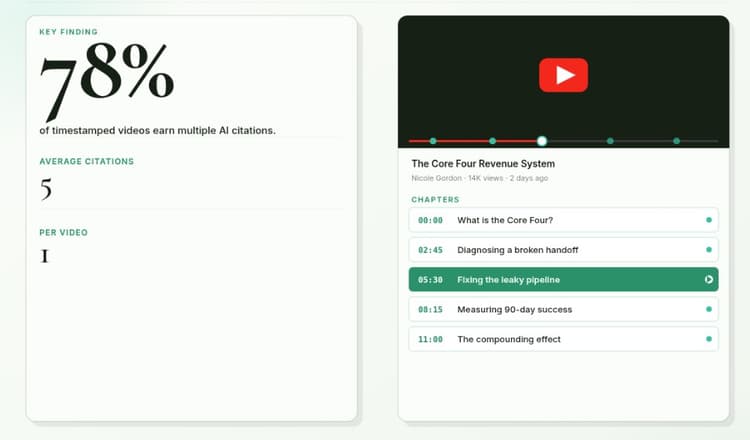
The play that works is different. Pick one founder problem. Build a 10 to 20 minute video that solves it step by step. Use a named framework. Cite real numbers. Add chapters every two to three minutes. Upload a clean transcript instead of relying on auto-captions. Write the description like a blog intro with the answer in the first sentence.
Do that once a month for six months. AI engines will start citing you on the question you answered. That is the visibility play. It compounds. A well-structured long-form video keeps earning citations for years after publication.
of AI-cited YouTube videos have fewer than 1,000 views. Channel size and subscriber count have near-zero correlation with how often a video gets cited. Structure and specificity matter far more than reach.
Why cutting long-form into Shorts is not the workaround
There is a tempting shortcut here. Record one long-form video and chop it into 12 Shorts. Get the engagement metrics on the Shorts and the citation value on the long-form. Best of both worlds.
That is not how it works. The Short does not earn its own citation. It also does not boost the long-form parent video in the eyes of AI engines. The two operate on different rails.
If Shorts serve a purpose at all, it is to drive traffic from social discovery back to the long-form video. They are a top of funnel asset. They are not a substitute for the real work.
The bigger shift founders need to see
Search is moving. Google AI Overviews, ChatGPT, Perplexity, and Gemini are answering more queries directly, without sending users to a website. The brands that show up in those answers will own the next decade of organic visibility. The brands that do not will quietly disappear from the conversation.
For founders building toward a hundred million, this is not a marketing question. It is a distribution question. The companies that figure out how to be the source AI engines cite will compound visibility every month. The companies that keep chasing Shorts will keep wondering why their organic reach is shrinking.
The gate is long-form. Walk through it.
Frequently Asked Questions
How long should a YouTube video be to get cited by AI search? +
The sweet spot is 10 to 20 minutes. This range accounts for 32.1 percent of all AI-cited YouTube videos. Videos under two minutes are cited only 5.7 percent of the time.
Do YouTube Shorts get cited by AI search engines? +
Rarely. Shorts and videos under two minutes account for just 5.7 percent of AI citations. They are a poor investment for founders trying to build AI search visibility.
What type of YouTube content gets cited most by AI? +
How-to and instructional content is the most cited category. AI engines treat YouTube like a reference library and prefer videos that answer specific questions clearly and step by step.
Do I need a big YouTube channel to get cited by AI? +
No. Over 40 percent of AI-cited YouTube videos have fewer than 1,000 views. Channel size and subscriber count have near-zero correlation with citation frequency. Structure matters more than reach.
How fast can a new YouTube video start getting AI citations? +
New, well-structured content can enter AI citation pools within three to five business days, often faster on Perplexity. Building sustained citation authority takes 60 to 90 days of consistent publishing.
Why do AI search engines prefer long-form video over Shorts? +
AI engines extract content from transcripts, structured metadata, and descriptions. A 30 second Short does not produce enough material for an AI to meaningfully quote or reference. A 10 to 20 minute video does. AI engines treat YouTube like a reference library, not a social feed.
Should I cut my long-form YouTube videos into Shorts? +
Cutting long-form into Shorts does not create AI citations. The Shorts do not earn their own citations, and they do not boost the long-form parent video in AI search. Shorts can drive top of funnel traffic to long-form videos, but they are not a substitute for the long-form work itself.
Source: AI Advantage Agency, "YouTube AEO Optimization." aiadvantageagency.com/youtube-aeo-optimization