A B2B revenue engine stands on four pillars, called The Core Four: messaging, lead generation, sales execution and RevTech. Messaging decides who leans in, lead generation decides how many conversations start, sales execution decides how many close, and RevTech holds the other three together so nothing depends on one person's memory. When one pillar is weak, revenue stalls no matter how hard the team pushes on the other three. The free Revenue Dependency Score measures all four pillars and names your two weakest.
Here is a pattern I see constantly. An owner builds a company to a certain number, and then it sits there. Year after year, the same number, give or take. They hire another salesperson. The number moves for a quarter and comes back. They buy more ads. Same thing.
The problem is not effort. The problem is that they are treating symptoms. Revenue is an output. It is produced by a revenue engine, and that revenue engine has four parts. I call them The Core Four: messaging, lead generation, sales execution and RevTech.
My job, when I work with a company, is to find the one constraint holding revenue back. Not five. One. This post is the map I use to find it.
Revenue is an output, not a strategy
When one pillar is weak, the whole revenue engine sputters, and no amount of pushing on the other three fixes it. That is why the usual fixes keep failing. More ads cannot rescue a message nobody understands. A new rep cannot close leads that never arrive. A better CRM cannot organize a sales process that was never written down.
So before you spend on anything, ask a different question. Not "how do we get more?" but "which pillar is holding the weight back?" Here are the four places to look, in the order I look.
Pillar one: messaging
This is where most companies are weakest and nobody notices, because weak messaging does not look broken. It just looks expensive. The test: can a stranger, in eight seconds, tell who your offer is for and what changes if they buy? If it's for everybody, it's for nobody. Positioning is a filter, not a megaphone. When your message speaks to a specific owner with a specific problem, your cost per lead drops, your close rate rises, and your sales team stops hearing "we need to think about it," because the message did the qualifying before the call. A law firm that put The Core Four to work had never crossed $200,000 in a month. Four months later it did $280,000. Messaging is where that work starts.
Pillar two: lead generation
Most owners believe this is their problem, and they are usually wrong about why. They think they need more leads. What they usually need is a system for the leads they already generate. It is a speed to lead game. The company that responds first, most often, wins the conversation.
Distribution is everything. The best offer in your category, followed up on twice, loses to a decent offer
followed up on twelve times. RAM Blog Post 5 · The Core Four Page 2 of 7The check: write down, in one sentence, what happens after a lead raises a hand. Who contacts them, how fast, how many attempts, over how many days, on which channels. If you cannot write that
sentence, you do not have a lead generation system. You have habits.
Pillar three: sales execution
This is the pillar with the most money hiding in it. Is your sales execution written down, or does it live in the head of your best rep? Do all your reps qualify the same way? When a deal goes quiet, does anyone own it?
Sales die in the maybe. A prospect who says "let me think about it" is not a no. It is an unmanaged maybe. The structure that fixes it is simple and uncomfortable: one written qualification standard every rep uses, one defined path from first conversation to signed deal with named stages, and one rule for what happens when a deal goes quiet.
An IT company went 24 consecutive months without signing a new client. With The Core Four in place, it signed 15 in the first six months. The market did not change. The structure did.
Pillar four: RevTech
RevTech is the CRM, the automation and the AI workflows underneath your revenue engine, and it is the pillar owners skip. The CRM that is half populated. The follow-up sequence that does not exist. The forecast that lives in a spreadsheet only one person understands.
The other three pillars cannot compound without it. Sharper messaging needs data on what converts. Lead generation needs automation to respond in minutes, not hours. Sales execution needs visibility, or you are managing by memory. If a commitment gets made anywhere in your pipeline, a system should catch it, not a person.
The check: open your CRM and look at the deals from the last 90 days. Count how many have a next step with a date attached. Every deal without one is leaking into the maybe pile. Take the free Revenue Dependency Score. It is 16 questions, takes a few minutes, and gives you an instant score out of 100 across The Core Four, plus your two weakest pillars.
How the four pillars work together
The pillars are not a menu. They are one revenue engine. Messaging feeds lead generation, because the right message brings the right people. Lead generation feeds sales execution, because a defined process needs steady input. RevTech runs underneath all three and catches what people forget.
That is also why owner dependence is a Core Four problem. When the message lives in your head, the leads route to you and the sales process is your personality, every pillar runs through one person. Go to market is the company, and the company runs on its systems.
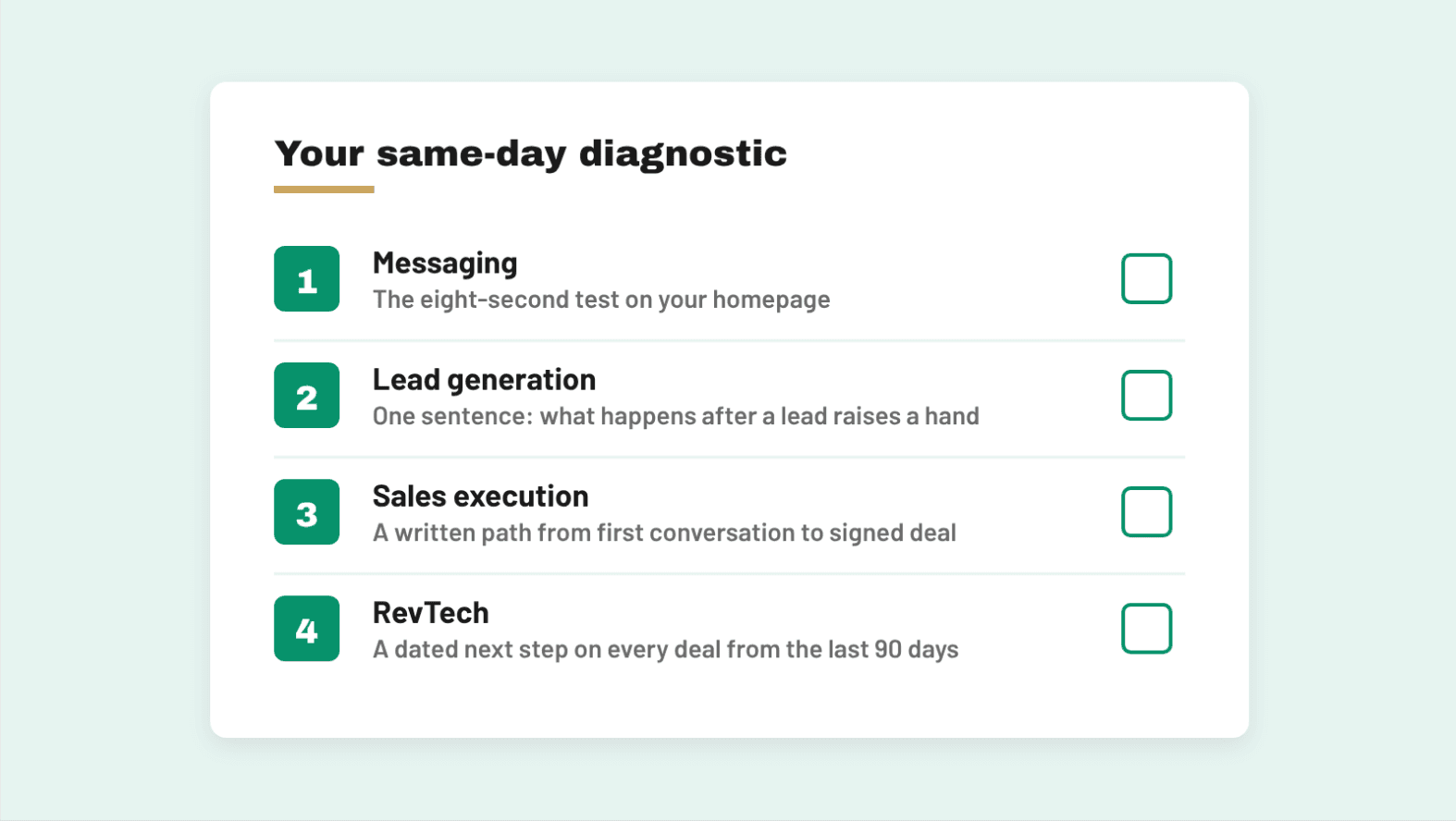
Your same-day diagnostic
Four checks, one per pillar:
1. Messaging: the eight-second test on your homepage.
2. Lead generation: the one-sentence test on your lead follow-up.
3. Sales execution: the written path test, from first conversation to signed deal.
4. RevTech: the next step test on every deal in your CRM.
Whichever check failed hardest is your constraint. Fix that one first. Not all four. One. The company that fixes its weakest pillar every quarter compounds. The company that dabbles in all four every quarter spins.
A $50 million IT services company put The Core Four to work and hit its full annual revenue goal by May. It did not need a heroic year. It needed four pillars holding weight.
If you want your number instead of your guess, take the free Revenue Dependency Score. The average company scores 52, and on our benchmark, companies above 70 grow about 2.5 times faster than companies under 60.