
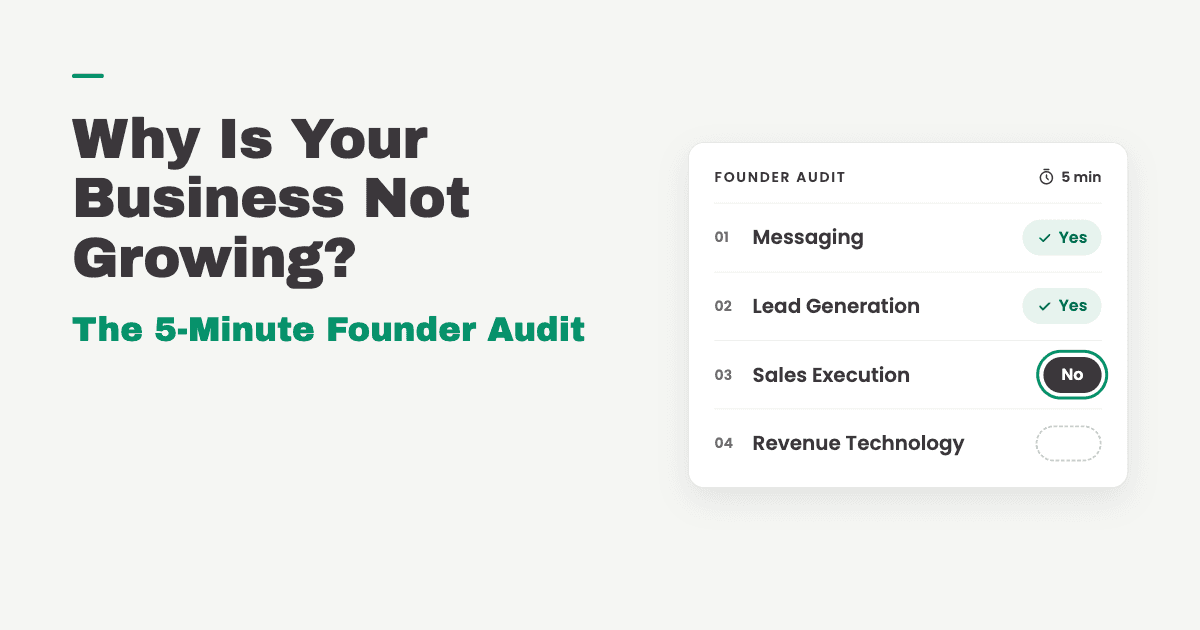
When growth stalls, most owners guess at the cause and spend money on the guess: more marketing, another salesperson, new software. The real cause is usually one weak link in four connected areas: your message, your lead flow, your sales execution, and the technology that tracks it all. The 5-Minute Founder Audit below asks one yes or no question for each area. The first no is where you start, because each area feeds the next. Fix them in order and growth has room to come back.
The Plateau Nobody Warns You About
You are working harder than you were two years ago. The team is bigger. The calendar is fuller. Revenue looks almost exactly the same.
Nobody warns you about this part. Starting a business takes hustle. Getting one unstuck takes something different, and most owners are never taught what that is.
So the question gets asked quietly, usually late at night, usually into a search bar: why is my business not growing?
The answer is almost never the market or the team. It is almost always that one part of the revenue engine broke, and nobody checked which one.
Why Guessing Makes It Worse
When growth stops, the instinct is to do more of something. More ads. More hires. More software.
Each of those costs real money. Each one is a bet on a diagnosis nobody made.
If buyers do not understand what you sell, more ads just put that confusion in front of more people. If deals stall because only the founder can close, a new salesperson inherits a job nobody can explain to them. The money goes out. Growth does not come back. The owner decides growth is just hard now.
It is not just hard. It is undiagnosed.
Growth rarely stops for one big reason. It stops at the weakest link in the engine, and most owners never check which link that is.
The 5-Minute Founder Audit
Set a timer. Answer each question with a yes or a no. No “sort of.” If you hesitate, the answer is no.
Minute 1: Messaging
If you asked three people on your team, separately, who you help and why customers choose you over a competitor, would all three say it the same way?
If not, your buyers are hearing from three different companies. That confusion shows up everywhere downstream. Here is why messaging comes first.
Minute 2: Lead Generation
Do you know where your next ten qualified leads will come from, without counting on referrals?
Referrals are wonderful. They are not a plan. If you cannot name the channel your next ten leads will come from, your pipeline runs on luck. Here is how lead generation works when it is built on purpose.
Minute 3: Sales Execution
Could a deal close this month without you on the call?
If every important sale still runs through the founder, the business can only grow as fast as one person’s calendar. Here is how to move beyond founder-led sales.
Minute 4: Revenue Technology
Can you open one screen right now and see your pipeline, your close rate, and what is likely to close this quarter, without asking anyone?
If those numbers live in three spreadsheets and somebody’s head, you are steering by memory. Here is what revenue technology should actually do for you.
Minute 5: Circle Your First No
Go back to the top. Find the first question you answered no. That is where you start. Not the loudest problem. Not the most expensive one. The first one.
Why the Order Matters
These four areas are a chain.
Your message decides who pays attention. Attention becomes leads. Leads become revenue through sales execution. Technology measures every step so you can see what is working.
A break early in the chain weakens everything after it. The 6sense 2024 Buyer Experience Report found that 81% of B2B buyers already have a preferred vendor by the time they first contact anyone. Your message is doing the selling long before your salesperson gets a turn. If the message is unclear, no amount of follow-up fixes it.
This is why fixing things out of order wastes money. Better software cannot rescue a pipeline full of the wrong leads. A great salesperson cannot rescue a message buyers already tuned out.
What to Do With Your Answer This Week
Pick the action that matches your first no. Do only that one this week.
Messaging: Ask three team members to describe what you do in one sentence, separately, and compare the answers.
Here is how to run that test.
Lead generation: Pull every deal you closed in the last 90 days and mark where each one came from. Your best source is usually obvious once you look. The 20-minute lead audit walks through it.
Sales execution: Write down the exact steps of your last three wins. If you cannot write them down, nobody else can repeat them. Delegation starts with that list.
Revenue technology: Choose three numbers to track weekly in one place: pipeline value, close rate, and average deal size.
A business that stopped growing is not a verdict on you as an owner. It is information. Once you know which link is weak, your next move stops being a guess.